Literally. So, no, this is not a post about carbon footprint procrastination.
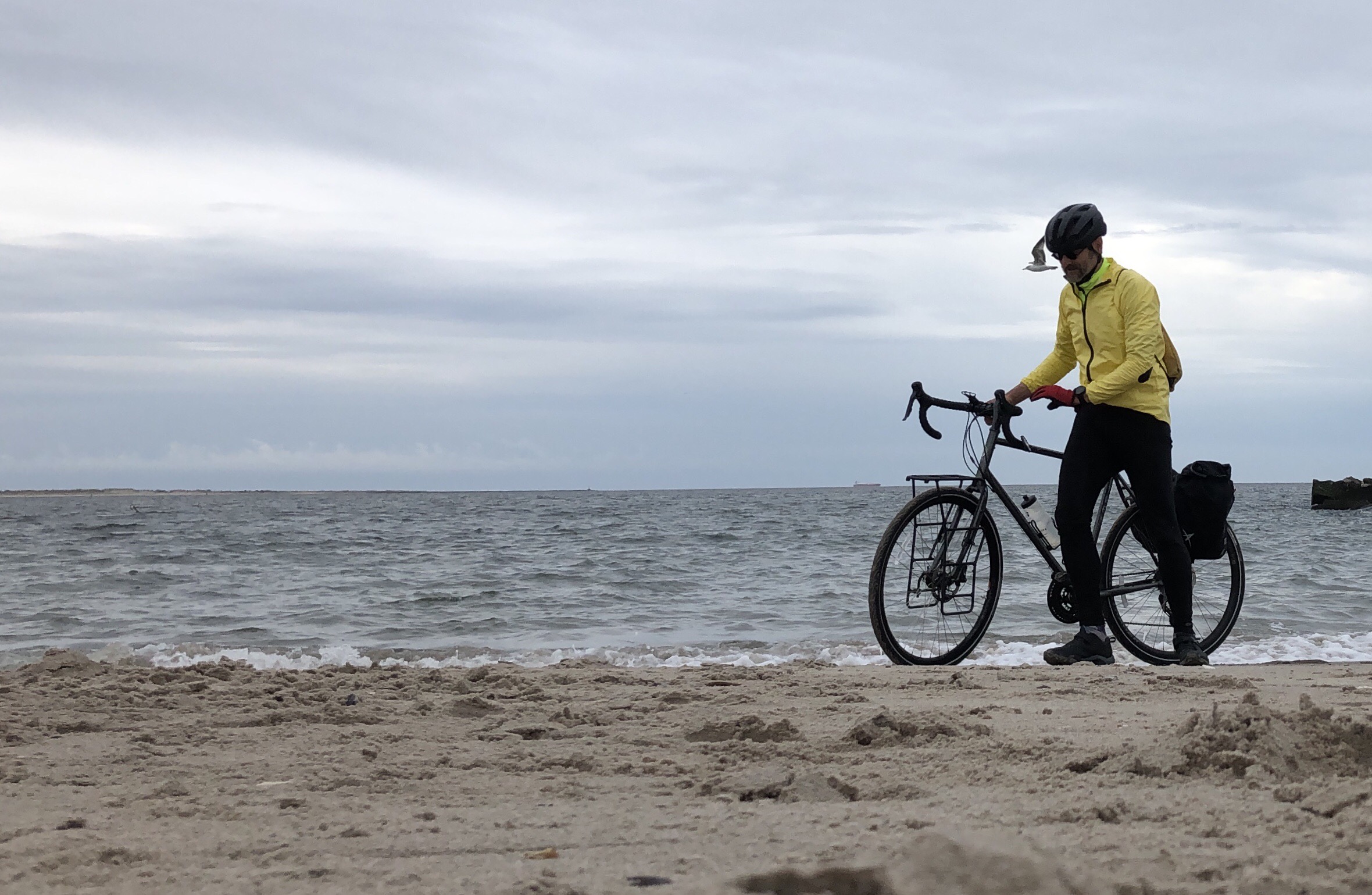
This blog has been about my mostly figurative low carbon journey in life, with some low carbon travel fun thrown in. Tomorrow afternoon I plan to leave home on a bicycle and point my wheel in a generally westward direction and keep going until I reach the Rogue River in Oregon for a whitewater rafting trip on June 23. I will try to post regularly about it on this blog at the request of a few of my friends who don’t do Facebook or Twitter. So, come along for the bike trip, and stay for the low carbon life tips!
Actually I completed the first leg of the journey on a bike last Sunday by biking from Coney Island and its Atlantic Ocean beach back home to Rockland County. With a stop in midtown for a Broadway show. Because low carbon travel should be fun, Robin’s birthday is coming up, and her favorite musical is Kiss Me Kate.
And I don’t mean to suggest that living the low-carbon good life means you have to ride a bike across the country. I am not sure I would recommend it – I am pretty much planning to have sore legs, knees and buttocks every day for the next seven weeks, and sleeping on the ground for most of it. I am not even sure my body can do it after 61 years living on this earth – stringing weeks on end of daily 90 mile rides may be too much for me. But I rode 92 miles in the Adirondack Mountains on Saturday, and I feel fine today.
Riding cross country is just something I have wanted to do since I discovered as a high school kid that a bicycle was the true American freedom machine for escaping the suburbs grew up in. That and a small sailboat. The stars have aligned to do the trip now, so I will try.
There are other low carbon travel adventures out there – a family of four could drive cross country in a hybrid or an EV without too large a footprint, and that family would have some great adventures on the way. As I hope to.
I’ll confess up front that I am not a fan of offsets. Addressing climate change will require people in the developed world to live with a smaller carbon footprint. We need to redefine the Western ideal of the “good life” to substitute a vision with less energy consumption. That will only happen when culture changes – substantial numbers of people start living a good life without emitting tons and tons of GHGs.
We need some conspicuous non-consumption right now in order to change culture to accept a lower carbon energy economy. And offsets get in the way of that happening, since people maintain their visibly big footprint lives while paying someone else somewhere else to pretty much invisibly reduce their carbon emissions.
The premise of carbon offsets is that you are paying someone somewhere to either reduce their GHG emissions, or capture and sequester GHG emissions, equal to the emissions from whatever you are doing – usually a fairly conspicuous form of GHG emissions like an airplane flight. Since your emissions have been “offset” by this net reduction elsewhere, for climate purposes, you have eliminated the effect of your own emissions and you can fly free of climate responsibility.
On a secondary level, paying for carbon offsets also has the climate protective effect of making our emissions cost more, which should make us cause less of them. We should only engage in GHG emitting activity that is really worth it. Offsets should work like a carbon tax, then. But most carbon offsets right now are so cheap (on the order of $10 per ton) as to be practically meaningless. No-one avoids a transcontinental round trip because the ticket price went up $10.
So for a carbon offset to be valid, then, it seems to me they should meet at least three of the following four principles
They should achieve the offset of your carbon emissions within twelve months of when your emissions occur. Climate impacts start immediately when the emissions occur and will become critical in a matter of just a few decades – so offsets far in the future really aren’t offsets.
They should provide economic benefits to communities that will suffer the greatest harms from climate change.
Number 1) is self evident, and is the baseline for all organizations certifying offsets.
Number 2) is key for me. Climate change is happening now, and our emissions today add irrevocably to the severity of climate impacts. Offsetting your six hour flights over the six decades it takes a tree to sequester your emissions is not really an offset. According to the IPCC SR15 report, we have about 12 years to ramp down global GHG emissions by roughly 50% if we are going to meet the 1.5 degree C goal of the Paris Accords. You are not offsetting, much less ramping down, your emissions, if the offsets take longer than that. In addition, the enforceability and additionality of offsets gets to be very speculative when we are talking decades in the future. For the globe to meet a net zero emissions target by 2050, pretty much everything now being sold as a low-hanging offset is going to have to be required by law. And don’t count on that forest conservation easement being enforceable in 2060 after some climate-related political upheavals have occurred. Some methane capture offsets might meet this standard. Few offsetting guidance documents look at the timing of the offsets, but they should. This one does.
Number 3) is essential if your offset is going to perform the economic function of limiting your emissions to those that are really “worth it.” It works like a pigouvian tax that way. If you aren’t willing to pay up for the amount of harm your flight will cause to climate-disrupted communities, then the world would be better off if you stayed home.
But a social cost based carbon tax is globally regressive. The world’s poor suffer the harms while the wealthier nations collect and redistribute the tax to their relatively wealthy citizens. So number 4) is a necessary element to make sure that the people being harmed by your emissions actually receive some compensation for that harm. The Gold Standards offset certifications includes consideration of sustainable development goals.
If you can meet three out of four of these principles, offsetting is at least defensible. But if you can’t meet number 2) (roughly contemporaneous offsetting), then you are not really avoiding the climate harm of your flight. You are just, through a combination of 3) and 4) paying compensation to the people who are harmed by your flight.
And since I believe that monetary compensation for climate harms can never really make up for the community dislocation, starvation, and personal suffering caused by climate change, I prefer not to rely on offsets at all in my own carbon accounting.
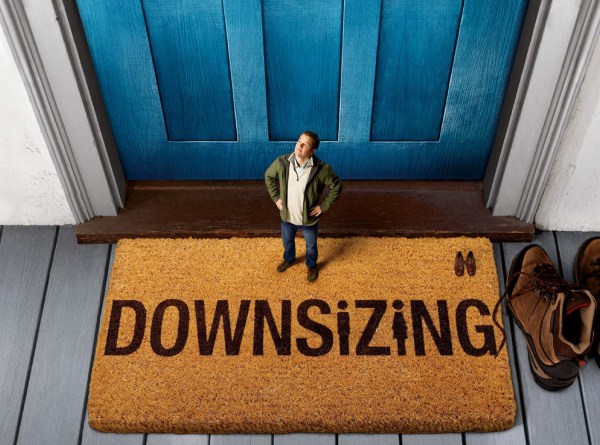
In the cli-fi movie Downsizing, scientists discover a way to shrink human beings and promote this form of downsizing as the solution to balancing human consumption with planetary boundaries. Only they don’t market the procedure as a way to protect the planet. Instead, the promoters appeal to status conscious consumerism. Think how much larger you can live if you are only five inches tall! The Matt Damon character falls for Leisureland, a micro development advertising early retirement in a large house for those who choose to shrink themselves and enlarge the relative value of their retirement savings.
Actually, the suburban neighborhood we live in sometimes feels like the consumerist wonderland of Leisureland. Except everyone seems to be working really long hours to pay their huge mortgages and utility bills. Can you spot which picture is the micro-McMansion from Downsizing and which ones are GoogleEarth images of my street? To be fair to my neighbors, all the houses here are custom designs. The neighborhood has an interesting history, having been founded as a socialist back-to-the-land cooperative in the 1930s.
Our house was one of the owner built houses from the original socialist colony. So, luckily, we live in a much smaller than average house – 1100 square feet small, to be exact. And that includes the spacious back porch. When trying to keep a small footprint, it helps, well, to have a small footprint.
Downsizing also refers to what empty-nesters do when the kids move out and the house gets too big for two. Some of my neighbors already complain that their houses are too big – even with kid at home, the spread out space means they hardly see their own family in their own home. That’s never been a problem for us – especially when we keep the thermostat low and a fire in the fireplace. Everyone stays in the living room by the hearth.
But becoming empty-nesters was an opportunity to reduce our appliance footprint as well. Our small house has a small galley-style kitchen. It works just fine for cooking great meals at home. But the refrigerator was not just an energy hog – it was a space hog as well. When we had to move the fridge to make way for some electrical work a couple of years back we saw how much more light and space we would have without it. So we bought a dorm-style mini-fridge and put a new marble counter in for more cooking space. After all, with a low meat, low dairy-fat diet and no kids in the house, there is not much to keep in the fridge anyway – just some milk and creamer, and the usual spoiling leftovers that will fill up however much space you have. Fresh veggies from the farmers market don’t really need refrigeration. And if we really want ice cream, there is a local ice cream shop a quick bike ride away. Oh, and the built-in beer can dispenser in the mini fridge comes in handy. New fridge price: $159.
More recently, our ten-year old gas dryer gave out – the igniter quit,. I have vowed never to replace any fossil powered appliance with another fossil powered appliance. But a full sized electric dryer would require rewiring the house for a 220 volt receptacle – an expensive proposition. I hate dealing with appliance repair appointments, but wasn’t sure I could diagnose or fix the igniter problem myself. So I put off doing anything until it got too cold and wet to dry all of our clothes on the clothesline. Then I went looking for apartment-style 110 volt dryers. And found one. For about $159.
The new dryer sits neatly on top of the washer, and works fine for the two of us. The space formerly occupied by the gas dryer makes a good parking spot for two bicycles, And I have evicted one carbon-spewing fracked-gas burning fossil powered appliance from our house and replaced it with a renewable-energy-contract cheap and easy electrical appliance that doesn’t count against my monthly carbon budget.
The movie Downsizing is a little ambiguous about the brand conscious consumerism that drives its plot. After all (SPOILER ALERT), at the end the Matt Damon character jumps ship from the techno-ecologist colony to throw in his lot with the consumer goods mercenaries and the Vietnamese political activist love interest. It’s not a great movie. Perhaps its point that the most effective way to get people to downsize their ecological footprint is to appeal to consumerist social envy is too well taken.That’s why Tesla EVs outsell Smart For Two EVs.
But even if we can’t downsize our bodies (and probably wouldn’t want to, not even for a McMansion), we can still downsize our footprint with smaller stuff that gets the job done.
So you voted for climate yesterday. Congratulations! You helped flip control of the House of Representatives to the Democrats. It is great that the party of climate denial no longer controls both houses of Congress. This is a necessary condition for effective climate policy. By “effective,” I mean climate policy that has some hope of achieving the sorts of reductions in the US (45% reduction by 2030) that IPCC SR15 says are necessary to avoid more than 1.5 degrees C of warming.
But a Democratic House, while necessary, is not sufficient to achieve effective climate policy. The House will be a check on President Trump’s worst instincts, but it can’t stop the Trump administration from withdrawing from the Paris Agreement and dismantling the Clean Power Plan. And the Paris Agreement and the Clean Power Plan were not enough, by themselves, to meet the GHG reductions described by IPCC SR15. To establish affirmative climate policy, the House would have to adopt new legislation – which in can only do with the concurrence of the Senate and the President. So flipping the House to the Democrats is really unlikely to lead to any measurable decrease in GHG emissions in the United States.
So as long as a climate denier occupies the White House and the party of climate deniers control the Senate, effective climate policy is impossible in the United States. Democratic control of the Senate and the White House are thus also necessary conditions for effective climate policy (or at least a veto-proof majority in the Senate). That can’t happen until 2020, at the soonest.
But even Democratic control of government, while necessary, is not sufficient for effective climate policy. We had Democratic control of the executive and legislative branches in 2009, and no climate legislation resulted. And while the Obama administration and EPA was the most climate progressive ever seen, it still did not take every possible climate mitigation measure in their power. Take a look at Clean Air Act section 211(c)(1) – it authorizes EPA to ban fossil fuels in transport any time it wants, based on the same endangerment finding that underlies EPA mileage standards and the Clean Power Plan.
Why isn’t Democratic control sufficient for effective climate policy? Because until politicians hear that climate is the number one issue for their base voters, it’s not going to make it to the top of the agenda. And climate is still far from the top issue for democratic voters.
So voting for Democrats, while necessary, is not sufficient for effective climate action. Democratic control of the House will not reduce greenhouse gas emissions in the US. Want to do something that will have a measurable impact on greenhouse gas emissions? Take a look in the mirror – the carbon mirror. Go to a greenhouse gas calculator that lets you plug in actual numbers for flights, natural gas, electricity, driving and diet, and see how your annual carbon footprint compares to the US average. Carbonfootprint.com and The Nature Conservancy have calculators that are pretty good for this (I have quibbles with both). Aim to reduce your emissions to below the US average this year – if you believe in climate action nationally, you should at least be able to get your own footprint below the average. Look at the four biggest items in your carbon tab (probably flying, driving, utilities, and diet), and aim to reduce each of those by at least 30% next year and 50% within three years.
But wait, IPCC SR15 gives the world 12 years to achieve a 45% reduction – why should anyone have to reduce now? The reason is that if you voted for climate, you are a climate leader (whether you think so or not) because most voters did not vote for climate. Being a leader means doing things first, setting an example that others can follow.
You will be able to measure your own footprint reduction immediately. And that is a measurable reduction in global greenhouse gas emissions. Yes, it is too small to affect global climate all by itself. But your vote was also too small to effect the result of any election all by itself and you did it anyway. And by leading a great life with a smaller carbon footprint you make your own climate message more powerful – studies have shown that climate action messages are more convincing when the messenger has made changes in their own life. Like voting for climate, it doesn’t make a difference if just one person does it – but if everyone who voted for climate yesterday cut their own fossil fuel emissions by 50% in three years, that would make a sizable dent in US emissions – and help overcome the political resistance to policies that reduce consumption.
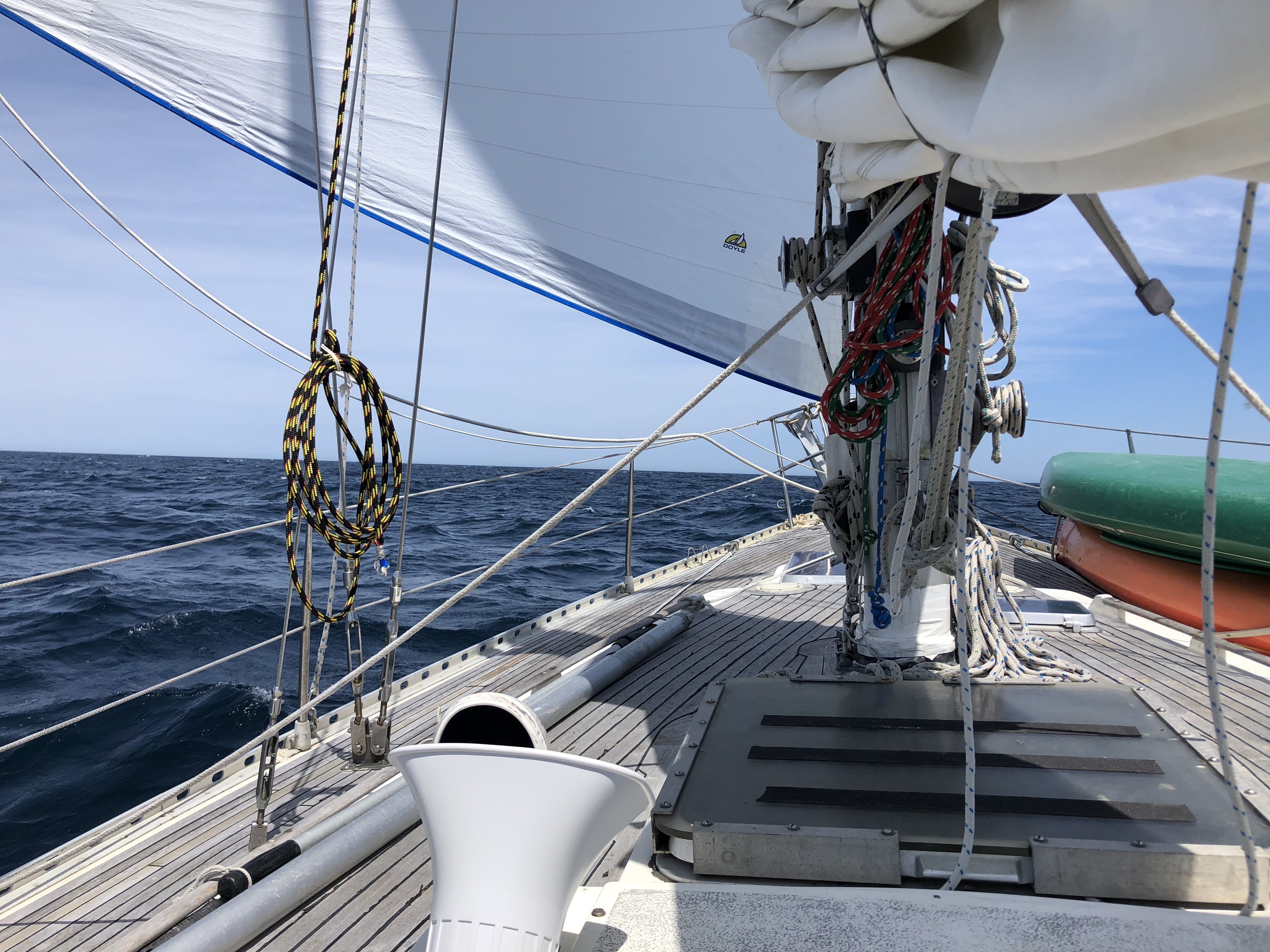
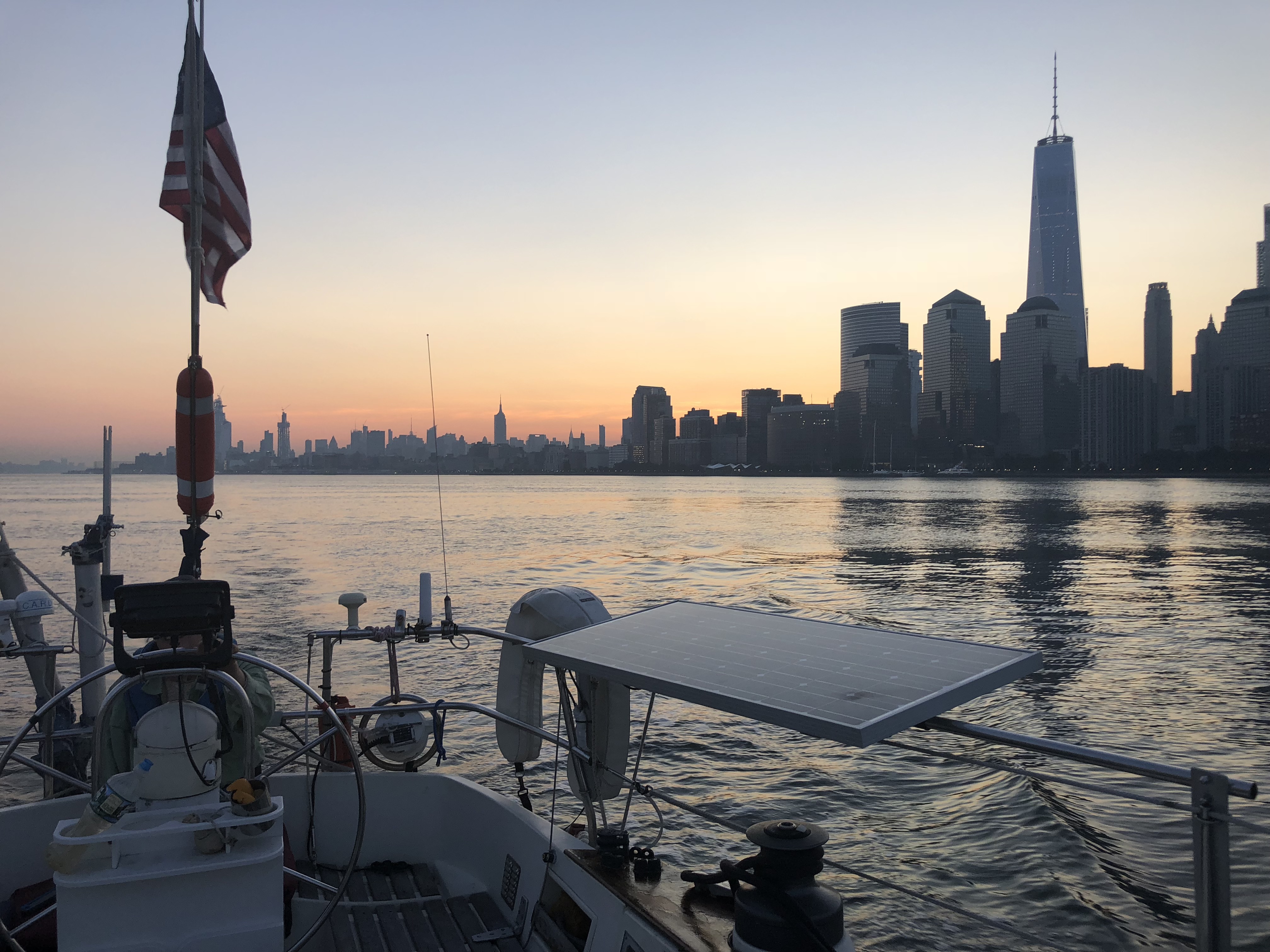
July in New York came in hot and humid. You can rack up a big carbon tab flying to a more agreeable climate and culture. Or you can sail north, say to Newfoundland, where July temperatures are in the 60s and 70s and the French island of St Pierre offers a taste of a small provincial village. Robin and I set off down the Hudson River for the ocean the afternoon of July 1 – the hottest day of the summer so far. Relief was immediate with a cool breeze, even on the river. We anchored overnight north of the George Washington Bridge and slipped out through the Narrows on the early morning ebb tide. By seven am we shut off the engine, pointed our bow east for Nantucket Shoals, and set our sails.
Sail travel is true slow travel. The passage from New York to St Pierre took eight days. The ocean south of Long Island was littered with mylar balloon trash – if you think releasing a balloon is magic, think again. But pilot whales and a breaching humpback visited us anyway. We spent the next three days ghosting in light winds and fog, then the fog lifted off the continental shelf and the breeze filled in for three sparkling days and starry nights as we ran offshore of Nova Scotia.
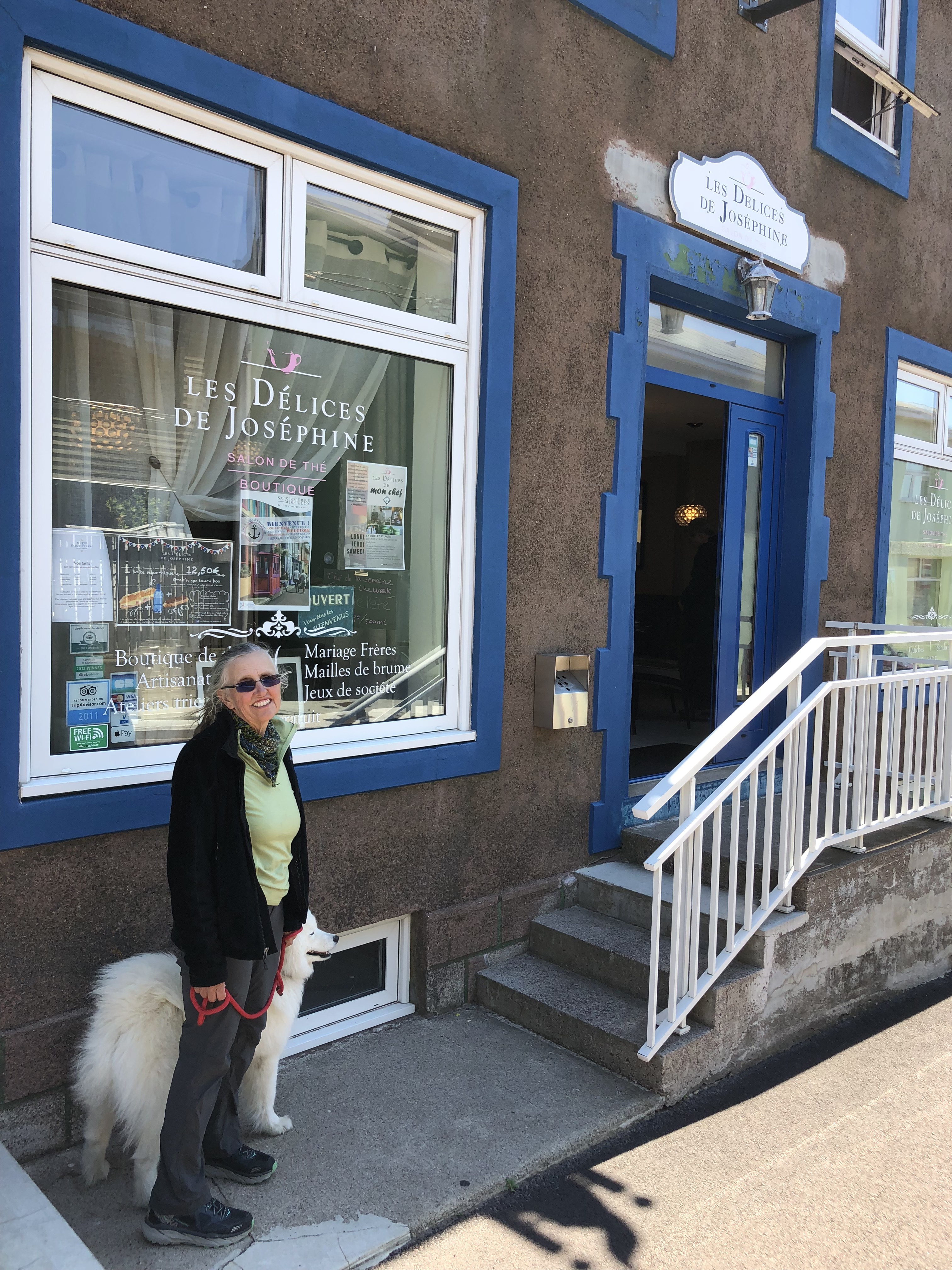
We had to run the engine four hours to get out of the river in light winds, then needed to run the engine one hour when we were becalmed in the fog in the Boston shipping lanes. One more hour to get us into the harbor in St Pierre, where the baguettes and quiche at Josephine’s Salon de The are still marvelous.
All tolled, that’s about five gallons of diesel to go 900 miles. My share of the carbon tab for the passage is 50 pounds CO2. Not bad
We spent five weeks this summer sailing to Newfoundland and back. Vacation travel is all about finding a change of place, and occasionally some solitude and serenity. Newfoundland delivered with cool weather, fog shrouded cliffs and deserted fjords — a welcome break from July in the NY motor area. And getting there by sailboat was relatively low carbon (we still burned some fuel getting in and out of harbors, and when becalmed).
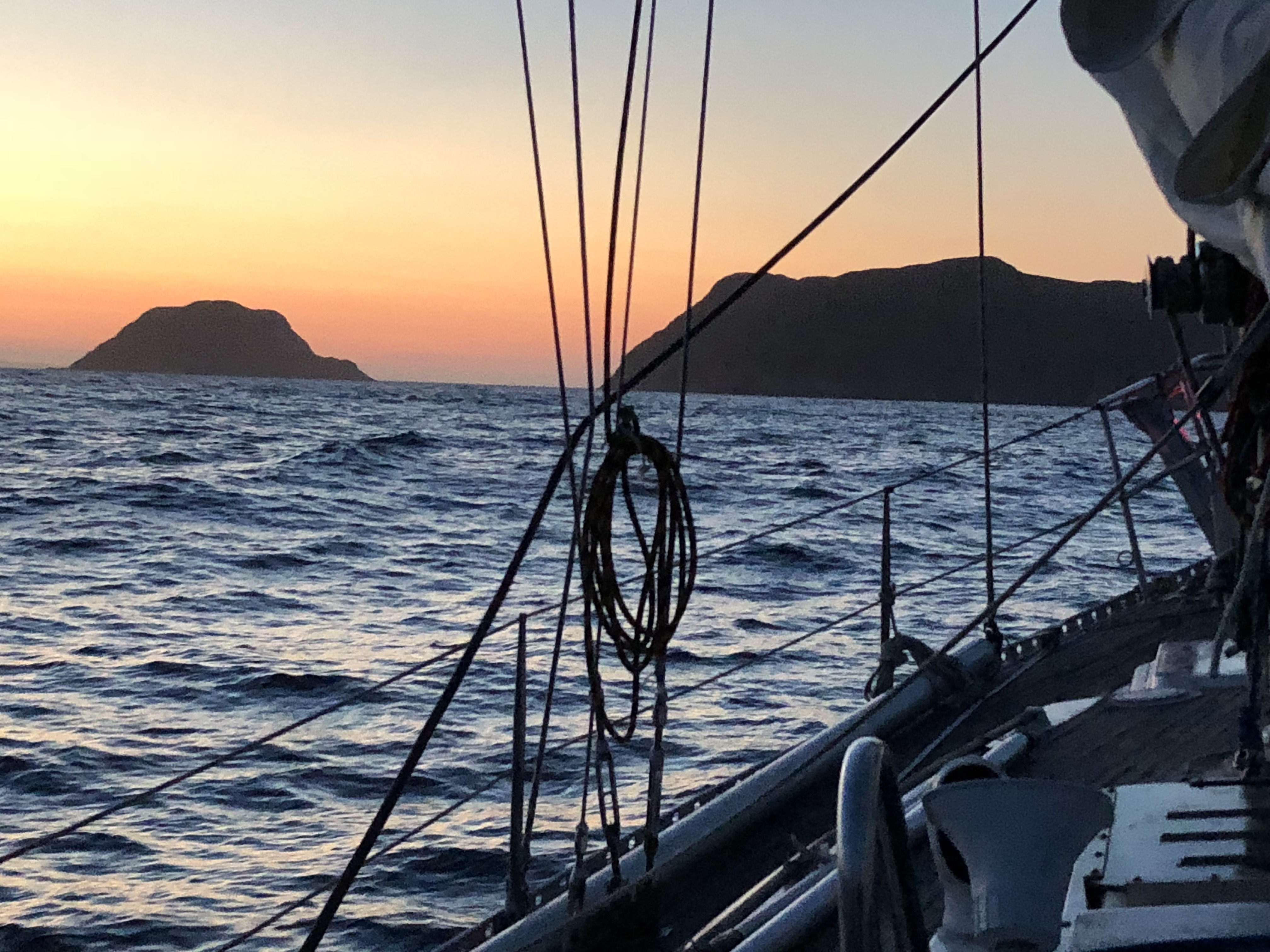
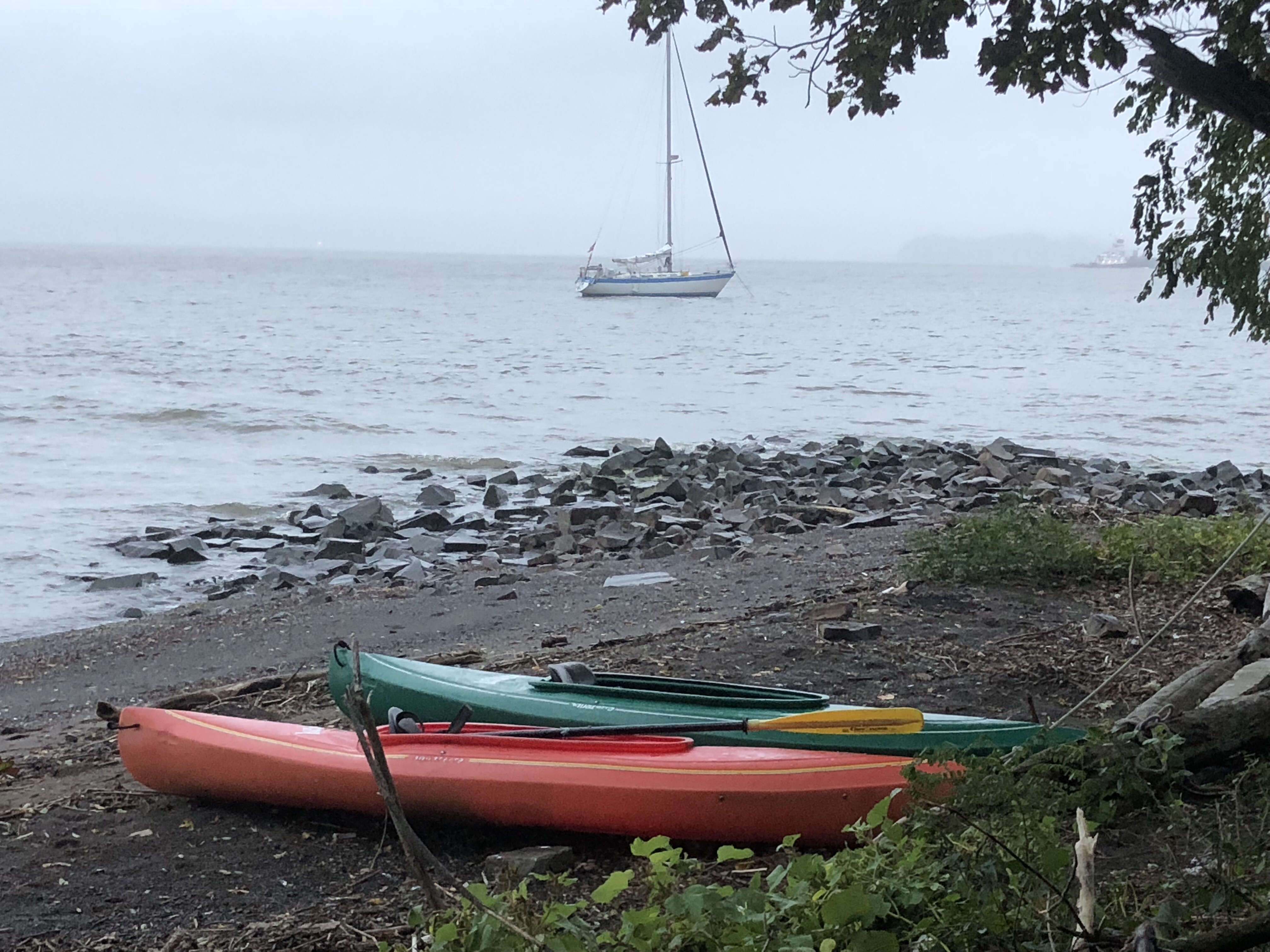
But one virtue of living in the Northeast is that a change of climate is never more than a month or two away. We returned to mist-shrouded cliffs and deserted wilderness the first weekend in October without burning any fuel and without traveling more than ten miles from our house. When the fog and drizzle rolled in a week ago Saturday, instead of holding up, we sailed north from Nyack with the flooding tide and a fair wind. Black Beach is one of those hidden gems of the Hudson – a small peninsula of black sand under the cliffs at the end of the Nyack Beach State Park bike trail. Eagles soar over these cliffs, foxes and deer come down to the waters edge at sunset, and coyotes howl at night. On a foggy evening in October, the woods are deserted and we might as well be in Newfoundland except for the occasional barge traffic to remind us we are on a commercial thoroughfare at the edge of the metropolis.
Locatourism generally beats locavorism as a way to cut your personal carbon footprint. Face it, it takes more energy to move your butt a hundred miles than to move a head of lettuce a thousand miles. Seek out that local change of scene!
This was the fifth year I went fossil free for Earth Week – making a vow not to buy or burn any fossil fuels, nor to ride on any fossil fuel powered transportation. The first year I went fossil free for Earth Week was 2013, and I have gotten by for one week without fossil fuels every year since except for 2013 when I was sailing my boat in the Bahamas with my brothers and nephew. I could not get around burning a little diesel to get in and out of harbors and a little propane to cook with that year.
So my fossil free week has become both routine an a ritual – I shut off the gas to the house, and dig out the electric induction stovetop. I hope for good enough weather to ride my e-moto and do my bike and kayak commute for the week, with my little Smart EV as backup for rainy days. Even riding a bus or Metro North commuter rail would be using fossil-fueled transport – public transportation is not emissions free, not yet. Robin goes along with this particular climate devotional eccentricity of mine, and we both trade hot showers for hot sponge baths for the week.
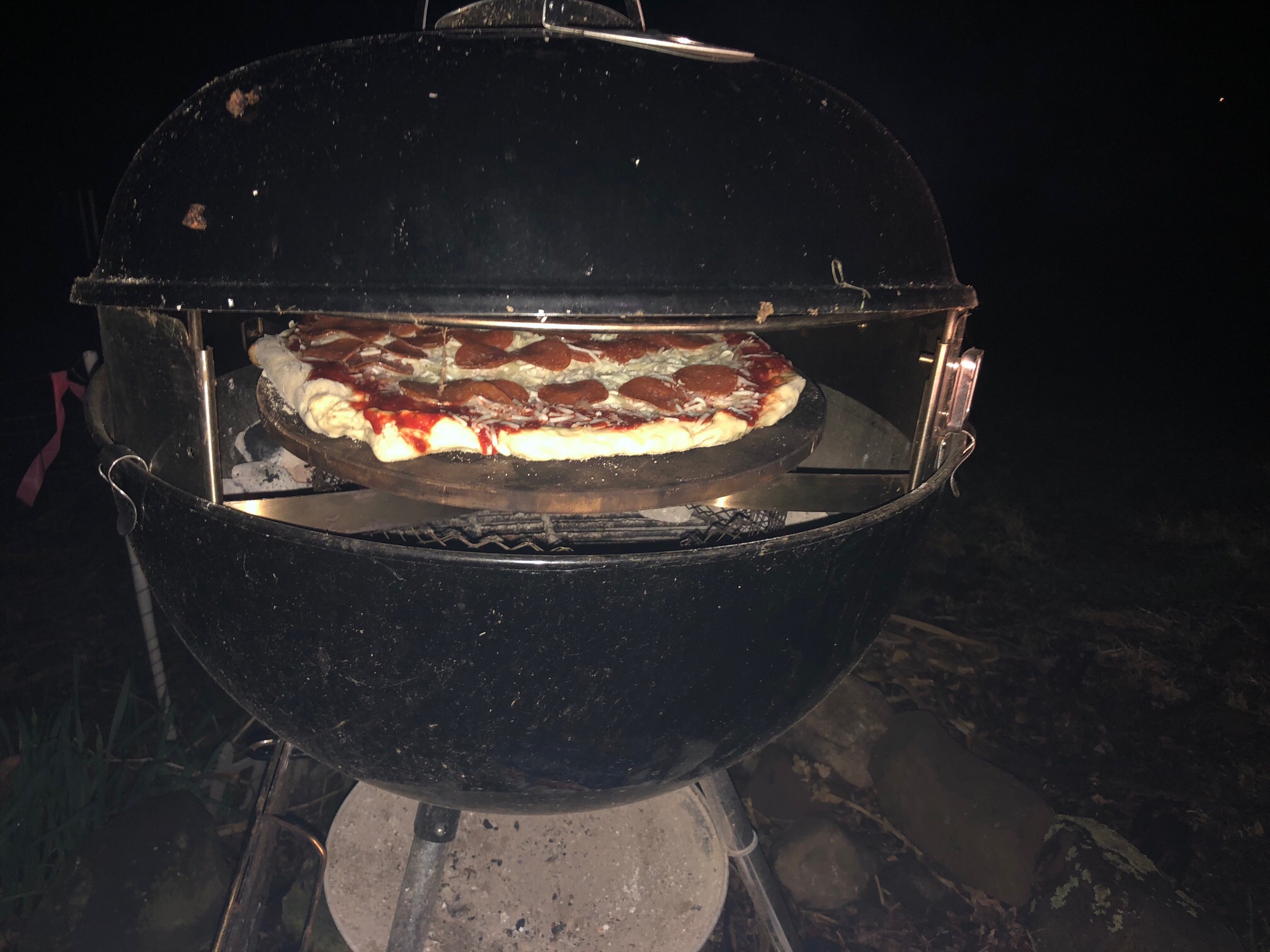
Not that fossil free week year didn’t have its challenges- our son’s girlfriend ran the Boston Marathon on the Monday of my Earth Week, and they were stopping over on their way back to Pennsylvania, and she specifically requested one of my homemade pizzas for dinner. Which I usually make in the gas oven. Lucky for me, a couple of years back I impulse purchased this gizmo that turns your charcoal grill into a pizza oven! So Danielle got her homemade pizza without busting my fossil free vow!
Yeah, I know, charcoal is processed with fossil fuels – but the heat energy from burning charcoal is biomass based, theoretically renewable, so it passes my fossil free test.
We capped off the week with a neighborhood paella party with a wood fire cooked paella – with windfall wood from our backyard.
Totaling up my carbon bill for April, my direct carbon impacts (gas, gasoline, meat eating, electricity) was 214 pounds, or about one tenth of a ton. That’s about as low as it gets. I am well on track for my four ton annual budget. Did shutting off the gas for one quarter of the month reduce my gas footprint? Well, we used 19 ccf of gas during March (870 heating degree days) but only 13 ccf of gas during April (603 heating degree days).
We spent a long Easter Weekend traveling to our off-grid mountain retreat and visiting our kids in Montreal. Two or more people in a hybrid Prius is still close to being the most carbon efficient means to travel – at least until we get 100% renewable energy charging stations for EVs. A 50 mpg hybrid gets 100 passenger miles per gallon with two people in it, or about .2 pounds CO2 per passenger miles. This is much better than Amtrak (.37 lbs CO2/pm) and comparable to an intercity bus. So the 800 mile round trip only worked out to about 160 pounds CO2 per person for the travel.
We were already planning to drive to our cabin for the weekend, and when we figured out that both our son and daughter would be in Montreal (she is studying physics at McGill, he was visiting from Pennsylvania), we couldn’t pass up the opportunity for a family reunion – the first time the four of us were going to be in the same place since November.
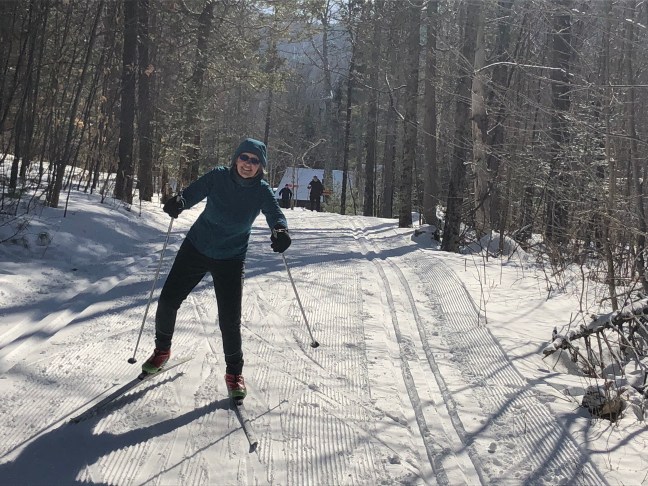
The drive from North River to Montreal passes right by the Adirondack high peaks. It has been years since Robin and I have skied the spectacular Avalanche Pass trail together. You never know when you might be missing your last chance. Robin’s ankle has been bothering her, but we had Nara the ski-joring Samoyed with us to help her with the ascent and the 12 mile round trip. Though the conditions were a little sketchy – hard packed boot-holed snow in the shade, slow slush in the sun – the climb was worth it, as always, and the ski back down and out went fast.
In Montreal, we took a walk through the old city. The Old World architecture transported me halfway to France, but the North American road hog automobiled kept my spirit from getting the rest of the way there – the Montreal streets just feel too American that way.
A little over ten years ago the four of us sailed our little boat to the Continent, and spent the winter holiday in Val d’Isere, where we discovered traditional raclette cheese cuisine – melted cheese on thinly sliced meats, potatoes, and vegetables. So naturally, we all went to the Restaurant La Raclette for dinner to reminisce. Though they did not roll out an entire wheel of raclette cheese for the table like they did in the French Alps, there was still a lot of cheese for each person! Since cheese has a pretty high carbon footprint (about 13.5 lbs CO2 per lb of cheese, one half that of beef), the meal was a not insignificant part of the carbon footprint for the trip.
Sunday we took a walk to the top of Mont Royal, then drive back to our cabin in time to make a not-very-traditional open fire Easter Egg paella for our North River friends.
After another Spring backcountry ski adventure on Monday, we drove home early Tuesday morning. We spent a total of 13 hours of the weekend driving – more than I like, but a Quebec murder mystery by Louise Penney made the hours spin by. If you add the two hours of airport travel and connections, we did not spend that much more time traveling by car than our son did traveling by plane to get to Montreal for the weekend!
When we got home, I added up my carbon footprint for March – 356 pounds CO2E for the month, mostly for natural gas (114 lbs) and gas for our drives up north. This brings my total for the first three months of the year to 1240 lbs – well on track for my four ton budget with plenty to spare. Especially since the winter months are the biggest gas CO2 bill!
About fifteen years ago I had a really high cholesterol and triglycerides count at my annual checkup. I had never really paid much attention to my diet before that, since I was one of those blessed people who could eat pretty much anything without gaining much weight. Three cheeseburgers for lunch? Why not?
Back then, my GP automatically prescribed statin drugs for every patient with high cholesterol. I resisted. I was too young to have to take meds every day for the rest of my life. But to me, food is one of the essential pleasures in life, and I didn’t want to swear off meat, or any other food group, completely. Robin handed me Nancy Harmon Jenkins’s Mediterranean Diet Cookbook, which was already sitting on our shelf, and it pointed to a way out of my predicament.: A book full of delicious sounding food, all somehow associated with very low incidence of heart disease.
Jenkins quotes this description of the Mediterranean diet from a 1993 Harvard Medical School conference:
Plentiful fruits, vegetables, legumes and grains; olive oil as the principle fat; lean red meat consumed only a few times a month or somewhat more often in very small portions; low to moderate consumption of other foods from animal sources such as dairy products (especially cheese and yogurt), fish, and poultry; and moderate consumption of wine (primarily at meals).
Sounds good to me! As Jenkins puts it “A diet of Mediterranean dishes . . . will be healthful and satisfying but never austere.” Best of all, the med diet didn’t require me to totally give up meat or carbs or fats or anything else – just moderate my consumption of some foods. As an article on the NIH website puts it,
In a somewhat reductionist approach, the traditional Mediterranean diet can be considered as a mainly, but not dogmatically, exclusive plant-based dietary pattern.
Not dogmatically vegetarian! The Mediterranean diet, where red meat is either a garnish in small quantities or a rare treat at a celebration, is pretty good for the climate too, since beef and lamb have about the highest climate footprint among food choices (unfortunately, dairy products have big footprints, too). But part the Mediterranean diet and culture also includes “feast days” – usually religious celebrations, where people indulge in the rich food that is not part of their daily fare, so you can still enjoy these rich foods as a treat.
So that beautiful and savory minestrone soup in the picture above is good for my health and for the climate. But it’s not vegetarian – you start it by frying a little pancetta in the soup pot, and adding beef stock enriches the flavor. I am not dogmatic about vegetarianism. Or my climatarianism for that matter. When climate conscious friends chide me for eating some free range organic beef about once a month (13 lbs CO2 for an 8 oz portion), I just smile and resist comparing my meat eating to their jet travel (2000 lbs CO2 for a typical round trip flight). I might even get on a plane myself on occasion for a really good reason, as long as it fits in my carbon budget. We all deserve our occasional feast day.
After about three months of a Mediterranean diet, together with adding daily exercise to my routine, my cholesterol was back in the normal range.
At least it meant that the backup nasty gas furnace in my house did not come on once all month (we heat with a woodstove fired with backyard deadwood, mostly). That’s a first for the thirty winters we have lived in this house. And we still managed to have a pretty good month for cross-country skiing – by making two trips in the Prius to our north woods cabin.
My total carbon tab for the month came to 340 pounds, which is really low for a winter month. The largest part of this was the gasoline we burned making two round trips up north – that was about 200 pounds of CO2. Natural gas (the water heater still runs) added up to 114 pounds CO2. And I wasted 44 pounds of my carbon budget eating beef (part of this was ordering ribs at a restaurant and expecting pork ribs, but ending up with a beef rib).
With a modest carbon footprint for February, I can look forward to having some to spare later in the year when we make summer travel plans. But I am still more likely to sail someplace interesting than to fly there.





 Our house was one of the owner built houses from the original socialist colony. So, luckily, we live in a much smaller than average house – 1100 square feet small, to be exact. And that includes the spacious back porch. When trying to keep a small footprint, it helps, well, to have a small footprint.
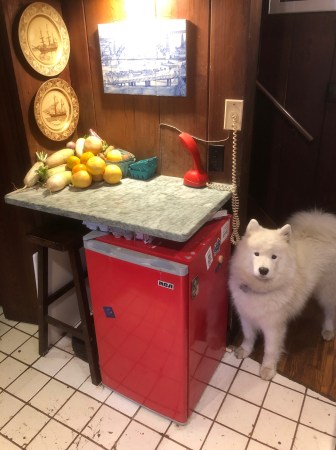 But becoming empty-nesters was an opportunity to reduce our appliance footprint as well. Our small house has a small galley-style kitchen. It works just fine for cooking great meals at home. But the refrigerator was not just an energy hog – it was a space hog as well. When we had to move the fridge to make way for some electrical work a couple of years back we saw how much more light and space we would have without it. So we bought a dorm-style mini-fridge and put a new marble counter in for more cooking space. After all, with a low meat, low dairy-fat diet and no kids in the house, there is not much to keep in the fridge anyway – just some milk and creamer, and the usual spoiling leftovers that will fill up however much space you have. Fresh veggies from the farmers market don’t really need refrigeration. And if we really want ice cream, there is a local ice cream shop a quick bike ride away. Oh, and the built-in beer can dispenser in the mini fridge comes in handy. New fridge price: $159.
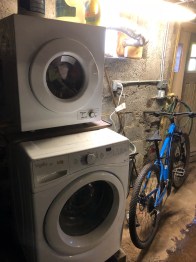 und one. For about $159.





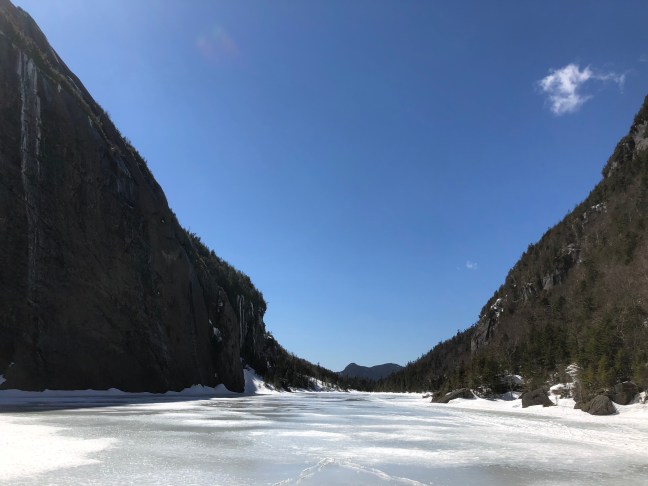
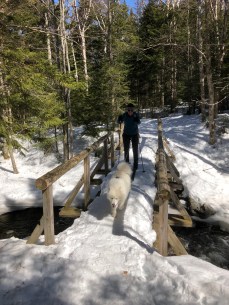 The drive from North River to Montreal passes right by the Adirondack high peaks. It has been years since Robin and I have skied the spectacular Avalanche Pass trail together. You never know when you might be missing your last chance. Robin’s ankle has been bothering her, but we had Nara the ski-joring Samoyed with us to help her with the ascent and the 12 mile round trip. Though the conditions were a little sketchy – hard packed boot-holed snow in the shade, slow slush in the sun – the climb was worth it, as always, and the ski back down and out went fast.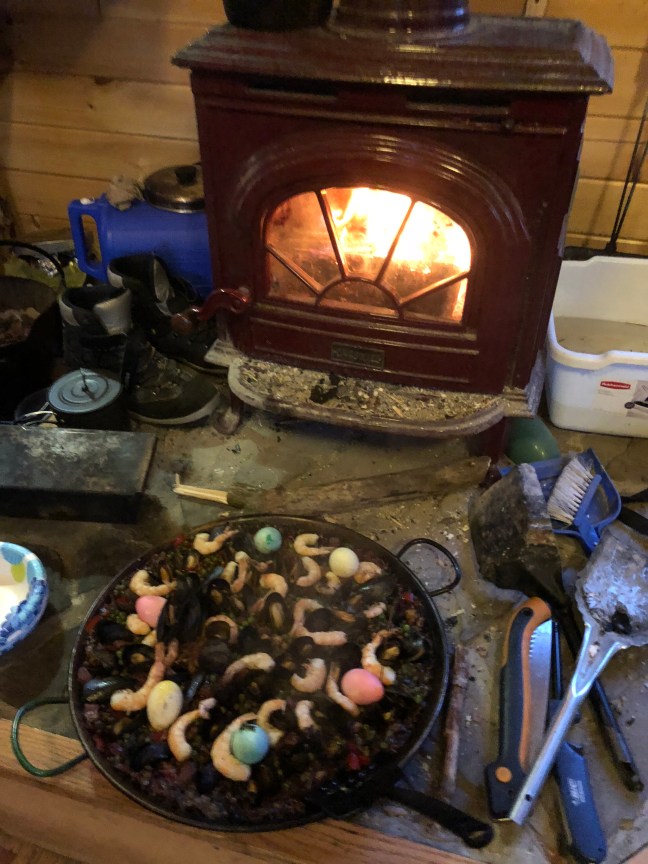


 Live! Sustainably! Now!