GETTING THE BUG OUT OF MY DIY HOME SOLAR POWER

IMG_1582

We got back from our sailing trip and switched the solar battery bank inverter back on.  We had turned it off because the batteries were a little low when we were leaving after a few cloudy days, and I wasn’t sure I could explain exactly how to monitor and switch the system to our house sitter.

The next morning, the inverter in the cellar was making the beeping sound that indicates a fault, usually a low battery.  The inverter is the electronic gizmo that converts 12 volt DC from the solar panels and the batteries (like your car battery) to the 120 volts AC that house circuits are wired on. It was beeping. But the batteries were full.

When I rebooted the inverter, it made an arcing noise and blue electrical sparks were visible out of the ventilation holes in the back.  Not good.  The inverter is about four years old, and out of warranty, but it shouldn’t be failing so soon. I made a mental note to add troubleshooting the inverter to my weekend chore list, but I also started pricing replacement inverters online.

Still, based on what I remember from my electronic/ham radio/geek days of high school, I thought that arcing was an unusual way for electronic components to fail. Electronic components usually just burn up.  Arcing requires high voltage bridging an air gap so narrow that the air turns into an electrical conductor — sort of like mini-lightning. So it might be worth opening the unit up (carefully!) to see if something got inside to bridge the air gap between high voltage components.

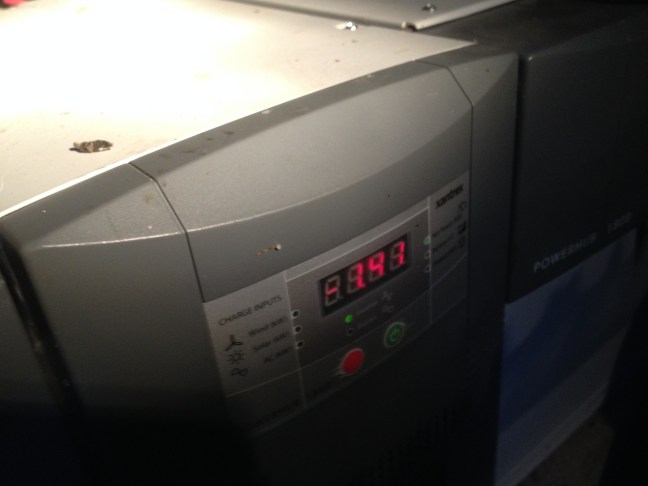
Sure enough, poking around with a stiff insulated wire where the arcing had occurred, I pulled out a crisp object.  An actual bug. You can see the bug on top of the inverter case in the picture above. After  removing the bug and smoothing out the burned edge of the circuit board, the arcing went away.

The inverter is back on and has been happily powering our (smallish) fridge since Saturday.


A Low Carbon Vacation in the Age of Sail

DSC_4341

A Low Carbon Fourth of July Weekend

IMG_1493

A fishing trip to the ocean, an evening listening to surf on a secluded beach, barbecues with friends, and our local fireworks display all on 50 pounds of CO2!

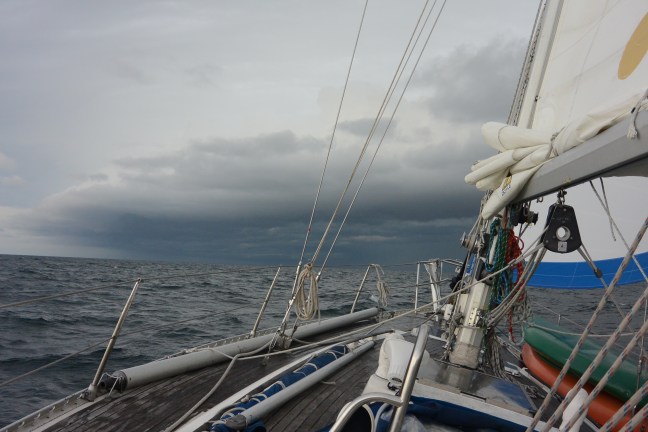
One nice thing about having a sailboat is that traffic is not an issue, usually,  But weather and tide is, so we waited Friday night until the tide was ebbing, the wind had shifted to the northwest, and the thunderstorms had passed through. We slipped out moorings at around one thirty and sailed silently down the river until the wind died and the tide turned, near the Englewood boat basin north of the George Washington Bridge. We slept soundly until the tide turned back to the ebb in the morning, just as the north west wind filled back in, for a delightful sail through New York Harbor out into the open ocean

We sailed along the coast on the brisk northwester as far south as Monmouth on the Jersey Shore.  We trolled the whole way, and changed course a couple of times to pass near the fish slicks, but no luck!  The fish were active, but my lures were not (anyone know where I can find a red and white rat-l-trap lure to replace the one that big bluefish swam off with?).

13557767_10208661537429013_5023546202192524503_n

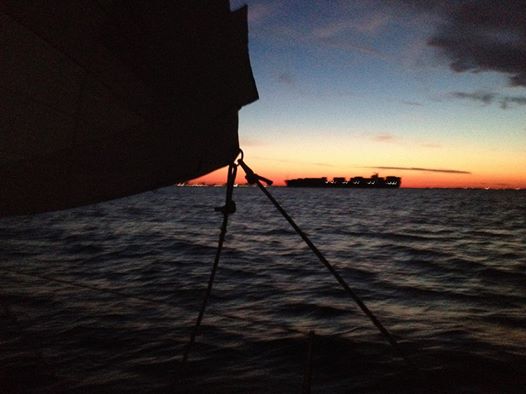
We anchored Saturday night on the ocean side of Sandy Hook, ten miles south of the entrance to New York Harbor.  With the wind from the west, this open anchorage was quiet, and secluded – just the sound of the surf and gulls on the deserted beach.  We only rolled a bit when the container ships went through the Ambrose Channel.

13600314_10208663463437162_9133241358999805485_n

Sunday morning we got up at dawn to make the morning flood tide, and got lucky with the wind, so we were able to sail up through the Narrows and right up to the Battery in Manhattan before losing it and starting the engine. We had to motor for four hours — about three gallons of diesel – to get back to our mooring in Nyack.  This was most of our carbon footprint for the whole weekend. Note to self — I have to look into  running the boat engine on bio-diesel on occasions like this. We might have waited for the evening tide and a better wind forecast, but we had a barbecue in Cold Spring to go to  . . .

Sunday afternoon we drove our electric Smart for Two to Cold Spring to a Fourth of July barbecue at Andy Revkin’s house — great people, great food, great music.  It was at the edge of the car’s range, but we brought the power cord just in case.  Monday, the Fourth, was a lazy day at home with nothing planned, and time to catch up on yard chores.  We were invited to another barbecue that evening (my CO2 footprint for the weekend includes the beef in the hamburger), then went back to our boat to watch the tail end of the Nyack fireworks from the water.

A month of Fun Days

Didn’t end up blogging much in June because I was too busy traveling and having fun (all on a carbon budget).  I spent the first week of June in North Carolina, attending the Waterkeeper Alliance annual conference in Wilmington, then paddling the French Broad River with the Waterkeeper Pirate Society, a loosely disorganized band of river recreation lovers. Though I took Amtrak down to Wilmington, I broke down and took a flight back from Charlotte, since that was the only way I could make it on the river trip and get back to New York in time to teach my Thursday afternoon class. Though short hop flights are more carbon intense per mile than long haul flights, it was still a short hop (fewer miles), and the flight fits in my carbon budget for the year.

Back in New York, I had one last weekend with my just-graduated-from-college daughter Beryl before she left for Vancouver.  So we took a family sail down the Hudson from Nyack to NY Harbor and out into the ocean.  I hooked a big bluefish, but it got away.  Robin and Beryl were screaming and cheering – not about the fish, but about the humpback whales breaching within fifty feet of the boat, within a mile of Rockaway Point in New York City.

We needed a weekend at home to catch up on chores, but that didn’t stop us from taking a quick overnight sail to our idyllic Hudson River anchorage off of Black Beach in Hook Mountain State Park.  Somehow, I got on the list for a transportation survey being conducted by the US Department of Transportation.  They had to call me back to confirm that my routine Saturday travel included travel by sailboat from Haverstraw to Nyack.

IMG_0798

Then, last weekend, we spent a long weekend up at our cabin in the Adirondack cabin.  Got some work-work done remotely then fast hiked up Blue Mountain on Friday, Saturday we went mountain biking on the Garnet Hill trails to a swim in 13th Lake, and Sunday and Monday we spent canoe camping on the Cedar Flow in the West Canada Lakes Wilderness.

So June was a lovely month of fundays.  My carbon total for the month was about 755 pounds — the biggest single month carbon footprint yet since I started keeping close track last September. That’s what fossil powered travel does. But my nine month total carbon footprint is  under 4400 pounds, just over two tons, so I am still well on track for my four ton annual carbon budget.No one can say I am living a deprive life!

AMTRAK IS NOT AS GREEN AS I WOULD LIKE TO THINK

13241376_10208398753099569_3168495612563226782_n

I have been away for a few weeks, traveling to the Waterkeeper Alliance annual conference in Wilmington, NC and then floating a river with some Waterkeeper friends afterwards. I took the Amtrak train to Wilmington, feeling all hair shirted righteous about all the greenhouse gas impacts I was avoiding by riding the green rails for 12 hours instead of those nasty, carbon spewing airplanes for two.

EXCEPT . . . whenever I try and poke around to get the real truth about the carbon impacts of rail travel and tote up the numbers for my personal carbon budget . . .  all of my illusions are shattered and I get reminded that the only kind of long distance travel that is really sustainable is ocean sailing, or bicycling, or maybe packed into an intercity bus, or three people on a road trip in a Prius.

Here’s the problem: a 2008 Union of Concerned Scientists report on CO2 impacts of travel calculates Amtrak’s GHG impacts at about .37 lbs/passenger mile for the electrified NE Corridor, or about .45 lbs/passenger mile for the rest of the rail network.  That is actually not much better than flying.  Amtrak’s own website is now coy on the subject, stating only that the GHG impacts of rail travel are “less per passenger mile than either cars or airplanes.”

But . . . how much less?  When I work out my train trip to Wilmington using the UCS numbers, I get a total of 209 pounds of CO2, or about .1 ton of CO2. I ended up flying back from Charlotte, NC after our river trip (had to teach my class Thursday afternoon).  When I plug that flight into CarbonFootprint.com, it shows a CO2 emissions of .12 metric tons of CO2, or about .13 English tons of CO2.  So taking the train might only about 25% better than flying. And lots of long distance travel by train OR plane is not ever going to be consistent with a sustainable carbon footprint.

Things get even more complicated though, since air travel involves greenhouse impacts beyond just those caused by burning fuel — there’s water vapor and nitrogen oxides at altitude, which have potent greenhouse gas effects. Some studies suggest that the true air travel GHG impacts are double those implied based on fuel use — as much as 500 grams per passenger mile, or about one pound per passenger mile.  Amtrak would then be only half the emissions of flying.

Of course, if I want to feel good about my train travel impact, I can always just plug my rail miles into the Carbonfootprint.com calculator – they come up with just .01 metric tons for the same train trip, less than one tenth of the return flight.  Who should I believe, the Union of Concerned Scientists, or Carbonfoorprint.com?

Walking to Our Cabin in the Wilderness

WHAT’S WRONG WITH THIS PICTURE?

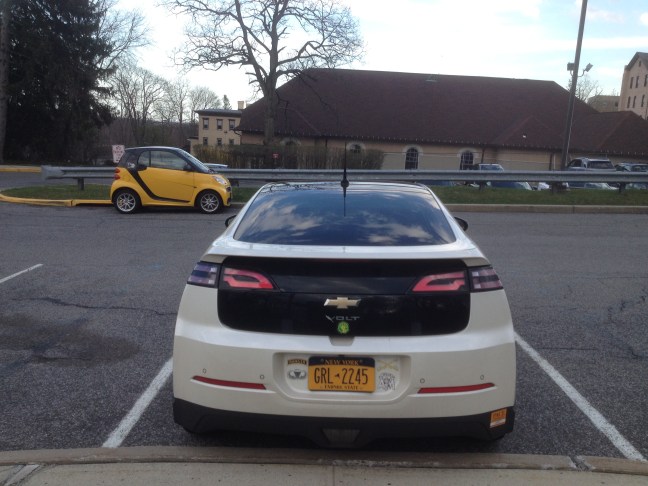
IMG_1326

This is the faculty parking lot at a recently renamed law school in New York with a world-famous environmental law program.  It is probably safe to say that every member of the faculty accepts that climate change is real and that it is caused by anthropogenic sources. It is also fair to assume that those on the faculty who do not teach environmental law probably don’t rank climate change as the most pressing social and economic issue facing the United States.

Some days, the view is a little more promising (once all those @#!!*&^ SUVs go home):

IMG_1257

I recently added up my carbon footprint for April — my personal footprint is 157 pounds for the month — less than 0.1 ton. It helps that I turned off the gas for Earth Week, and we only made one (one way) trip to the mountains (the return trip counts for May). Still on track for my four ton annual carbon budget.

A Low Carbon Trip to the Cup Races

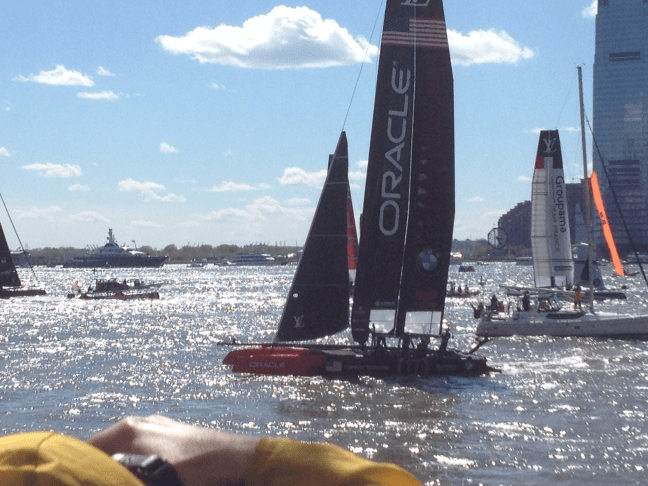
oracle

We weren’t going to miss the Louis Vuitton Americas Cup races in New York Harbor. The logical low carbon way to get there would have been to sail our boat down and back . . . but the boat is not in commission yet, and Robin has always wanted to try biking down the bike path on the west side of Manhattan, so we loaded two road bikes into the Prius on Sunday and drove the first ten miles of the way to the George Washington Bridge (my share: 2 pounds of CO2). We unloaded the bikes and rode down the top of the Palisades on Route 9W (one blown out tire, fortunately I had a spare tube and Robin knew where the bike store in Fort Lee was).

With a brisk tailwind, we made great time and could look forward to a good show with these high tech, high speed catamarans.  With a few near misses on the GW Bridge we made it to Manhattan with about twenty minutes to the first race.  Took some time to find the crossing to bike path, but it was a fun ride. We paced a Danish sailboat called Blue Bite all the way down the west side. They were bound for the Azores — we knew this because we spoke to the family crew at Haverstraw Marina on Saturday, where they were stocking up supplies and checking weather.

standandpic We caught the end of the second race, and all of the third race. The spectator area near the World Financial Center ferry terminal was close to the action, though I did have to stand high on my bike to look over the shoulders of the crowd. With a good breeze, we got to see the flying hulls and flying boats.

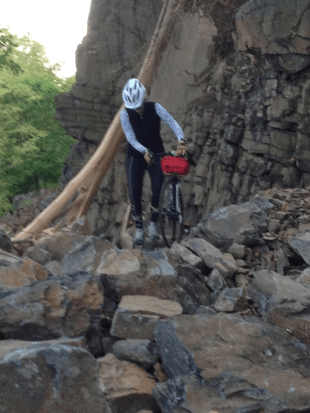
After the races, and hot pretzels, we took the ferry across to Jersey City (another 2 pounds CO2 for the one mile crossing — ferries are awfully inefficient as public transportation goes, less than 10 passenger miles per gallon of diesel). We biked up the boardwalks and parks of all the new condo developments on the Jersey side until we got to the Henry Hudson Drive entrance to the Palisades Park.  This narrow road took us through improbably quiet and secluded woodlands under the Palisades Cliffs right across the river from Manhattan and the Bronx. Several waterfalls in their Spring splendor enticed us to break up the uphills. waterfall  What we didn’t know is that a rockslide blocked normal access from the north end of the drive back up to Alpine and Route 9W.  Rather than backtack the whole seven miles to Edgewater, we humped our bikes (carefully) over the pile of rocks.rockpile

Tired and happy, we got back to our car at about six thirty, loaded the bikes in the back, and drove the ten miles back home (another 2 pounds CO2) for another sunset dinner on our porch.

Total greenhouse gas cost of a trip to the big city to see the races: six pounds of CO2. Seeing the cup boats in NY Harbor: Priceless.

FOSSIL FUEL DIVESTMENT: EMPTY SYMBOLISM?

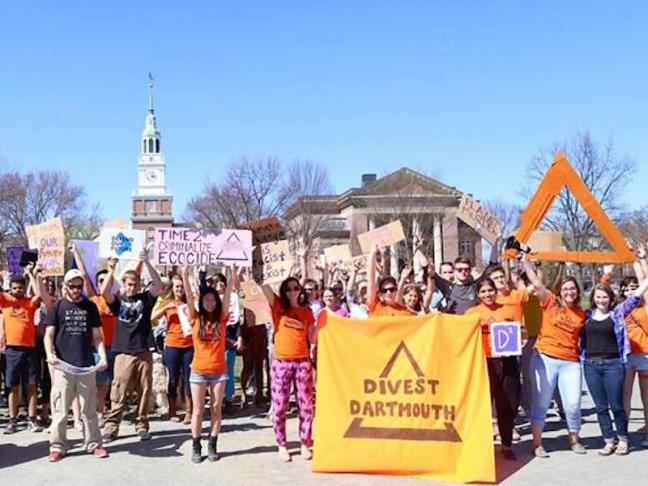
divest-dartmouth-courtesy-molly-seigel-20160430

Dartmouth is the most recent locus of the fossil fuel divestment campaign. I’ve got to admit I have mixed feelings about 350.org’s whole “fossil free” divestment movement. It’s a great way to get people engaged and involved, and to tap into the energy of students who want to relive the glories of past activist movements.

But the logic behind divestment doesn’t really work. The logic has to go 1) Universities and pension funds sell of their fossil fuel stocks, 2) the value of those stocks drops incrementally and fossil fuel companies become social pariahs, 3) ???????, and 4) fossil fuel company management decides to leave fossil fuels in the ground and go bankrupt instead of continuing to make money for their remaining shareholders by meeting the global demand for gas, coal, and oil. I don’t see how to fill in step 3) or anything that gets to step 4) other than a global ban on fossil fuels.

I’ll admit that the moral logic of divestiture activism by fossil fuel consumers also escapes me — it has to go something like this: 1) Extracting and selling fossil fuels is morally reprehensible (like apartheid) because the burning of fossil fuels causes catastrophic climate change that will destroy lives and ecosystems around the globe; 2) participating in this reprehensible enterprise by owning and profiting from investments is also reprehensible; 3) burning fossil fuels (which everyone who drives a gas or diesel car does) is not morally reprehensible, because using fossil fuels is (apparently) an absolute necessity; 4) producing and selling a product that our society (apparently) considers an absolute necessity is nevertheless morally reprehensible because (??????).

Why aren’t we organizing for a global ban on fossil fuels?

Although the fossil free movement likes to draw parallels to the anti-apartheid South African divestment movement, the apartheid protestors did not cover themselves with blood diamonds during their student years. University presidents can’t help pointing out the irony of privileged college students driving their fossil fueled cars around campus, while demanding an end to fossil fuel investments. As the Swarthmore Board of Managers put it:

Divestment’s potential success as a moral response is limited-if not completely negated-so long as its advocates continue to turn on the lights, drive cars, and purchase manufactured goods, for it is these activities that constitute the true drivers of fossil fuel companies’ economic viability-their profits. It is important that we ourselves acknowledge that our consumption of energy makes us complicit in the threat to the planet and that it is in our hands to reduce our demand for it.

Defenders of divestment as a strategy acknowledge these limits and point to the moral, organizational, and symbolic value in divestment. But there is a huge risk in devoting a movement to purely symbolic goals. The temperance movement has been analyzed as a movement devoted to symbolic goals rather than actually responding to any grievances. This may be why Prohibition failed.

So how about my own fossil-free stunt for Earth Week? Empty symbolism?

I’d like to think not, of course. It’s true that my own modest abstention from fossil fuels for the week has not lead to a decline in the profitability of fossil companies. But living without is liberating — I feel comfortable advocating for $15 a gallon gasoline because, frankly, it wouldn’t make a difference in my life. People whose lifestyle is dependent on the availability of artificially cheap fossil fuel energy have even more of a vested interest in continued fossil fuel production as a university with a small portion of its portfolio in ExxonMobil shares. Like the temperance movement, their support for the cause may evaporate once the cause starts to affect them personally.

If I can go for a week without any fossil fuels and be happy, then I could probably go for two weeks, or a month, or a year. Going without for a week reminds of those few things I still rely on fossil fuels for (hot water, driving long distances — both replaceable now or in the near future). We all have to start somewhere.

Meanwhile, this move by 350.org is a move towards more direct direct action, and can only be a good thing.

A LOW CARBON WEEKEND IN THE MOUNTAINS

IMG_1323Living with a sustainable carbon footprint does not mean you never go anywhere or have any fun. It just means you pick your fun carefully.  That means finding the mountains close to home.  We are lucky in New York State to have the Adirondacks just a few hours drive away.
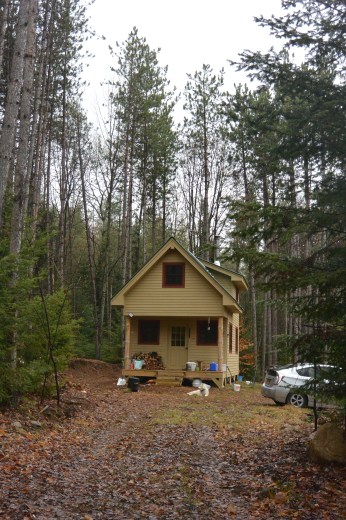
And Robin and I are even luckier, because two years ago we bought a few acres of land in North River, connected to the Garnet Hill cross country ski trail network, and built a small ski cabin there. We designed the cabin to be off the grid and off of fossil fuels.  It’s one open room with sleeping lofts at either end, a wood stove for heat, and a composting toilet Because there is no plumbing, we don’t have to heat the place when it is empty.  Four solar panels charge three marine storage batteries, wired to a twelve volt electric system for lights and small appliances. Instead of house current sockets, we have USB sockets to plug our phones and tablets into to charge.

Our cabin is nestled in a stand of red pines, in a larger stand of spruce and firs. All those evergreens give a distinct north woods flavor to the place, with a mountain ridge peeking over the trees. Friday afternoon we drove up in our Prius, stopping along the way to pick up some bees for Robin’s apiary. Saturday was a splendid Spring day.  Robin tended to her beehives all morning while I cut, split, and stacked more wood for next winter. In the afternoon, we went for a hike to the top of nearby Moxham Mountain and lay in the sun at the summit gazing across the valley to Gore Mountain. Saturday evening we threw another paella party for our friends in North River. We awoke to the rain on our tin roof Sunday morning – no matter, it was a nice morning to look through the windows at the mists, linger over a long brunch of waffles cooked in our woodstove, catch up on reading the Sunday Times, and finally go for a walk when the rain let up. Sunday evening I experimented with this kit I got to make pizzas in a barbecue grill (not quite designed right for our grill, so the bottom was blackened even though the top was a bit doughy). We stayed over Sunday night, and rose before dawn for a quick run before driving back downstate in time for Monday morning meetings.

DSC_3646It’s about a three and half hour drive from our house to our cabin – 210 miles each way. Running the cabin and living in it is zero carbon, since we light it with solar energy and heat it with dead and down trees from the land.  We een cook on the wood stove – though we have a propane camp stove as backup. The round trip in a 50 mpg hybrid takes about eight gallons of gas.  Split two ways, that works out to about 80 pounds of CO2 emissions for each of us – ten trips a year is less than half a ton of CO2 – so this luxury fits just fine in my four ton carbon budget. (Yes, I know, building the cabin used fossil fuels – but that emissions get spread out over the fifty year life of the cabin, so they will be pretty minor).

Getting to the cabin and the gas water heater and stove at home are my biggest remaining fossil-fuel dependent habits.  Our cabin is a bit beyond the range of our electric vehicles at this point, but in a couple of years, when the Tesla Model 3 hits the road, even getting away to the mountains for the weekend could be completely carbon free.